Too Alive to Mourn
There are many ways to lose someone.
Death is the cleanest.
Not emotionally. Not morally. But structurally.
A person dies and the world immediately produces a framework around the loss. There are funerals, rituals, photographs, speeches, awkward hugs, casseroles, cards. Stories emerge quickly. The dead become stable in memory. Their personality freezes into anecdote and mythology. Even difficult people soften once no further interaction is required of them.
Everyone understands their role.
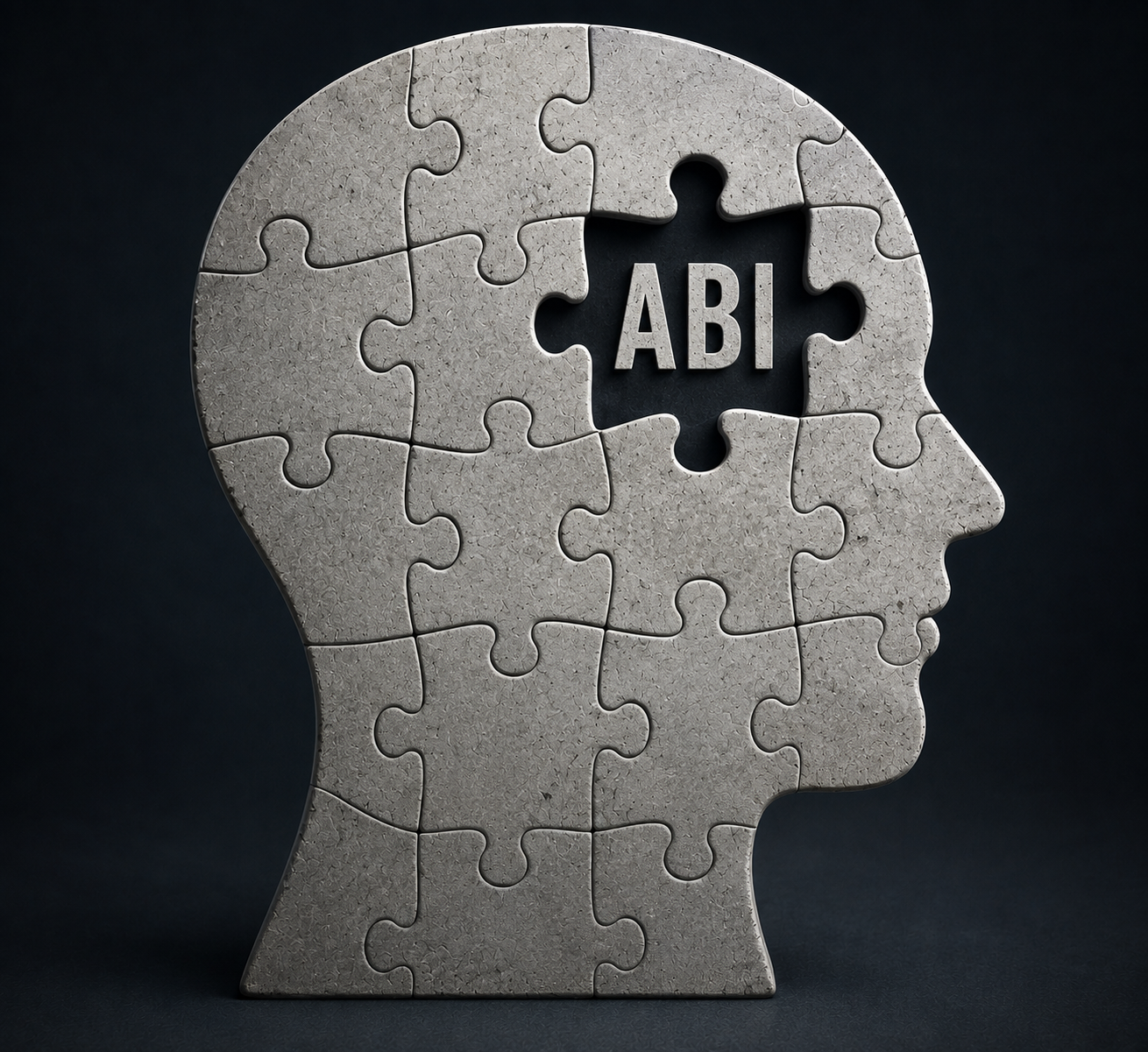
Brain injury does not permit that kind of coherence.
The person survives, but survival itself destabilises the narrative. The body remains. The voice remains, mostly. The history remains intact enough to be recognisable. But something underneath shifts in ways that are difficult to quantify and impossible to explain cleanly.
Humour changes.
Patience changes.
Tolerance changes.
Emotional regulation changes.
Confidence changes.
Pace changes.
Insight changes.
The ability to tolerate noise, complexity, uncertainty, conflict, social performance.
Sometimes the changes are subtle. Sometimes catastrophic. Usually they fluctuate enough to confuse everybody involved, including the injured person.
The result is a strange form of social ambiguity.
The person is still alive, so society assumes continuity. But everyone around them quietly senses discontinuity at the same time.
That contradiction sits underneath almost every interaction.
If somebody dies, grief is permitted. If somebody changes, especially neurologically, there is no socially recognised process for mourning what has been altered while still respecting what remains.
That is part of what makes brain injury so psychologically destabilising.
There is no clean line between before and after.
No reliable point at which anybody can say:
“This is no longer the same person.”
And yet most people involved suspect it privately.
Friendships begin to reorganise themselves around this uncertainty.
Not usually through cruelty. That would almost be easier. Cruelty at least provides clarity. Most friendship loss after brain injury happens through drift, ambiguity and gradual recalibration.
At first everybody rallies.
Messages arrive.
Visits happen.
Concern is sincere.
Then ordinary life resumes for everybody else while the injured person remains trapped inside an ongoing reconstruction project. Medical systems eventually discharge people. Friends psychologically do the same.
Most people move toward ease without consciously recognising they are doing it. Relationships requiring less emotional labour naturally regain priority. Conversations become less complicated elsewhere. Group dynamics quietly simplify themselves.
Nobody announces this process.
Nobody votes on it.
Nobody even fully notices it happening.
One day the injured person simply realises they are no longer central to the social architecture they once inhabited.
The difficult part is that there is rarely enough evidence to fully justify the sadness.
No explicit rejection.
No dramatic betrayal.
No obvious act of abandonment.
Only patterns.
Fewer invitations.
Less initiative.
Slight hesitation.
Subtle awkwardness.
Longer silences.
A sense that everybody else has resumed movement while you remain psychologically stranded somewhere between survival and reconstruction.
And because brain injury itself destabilises confidence, interpretation and emotional regulation, the injured person can never fully trust their own conclusions.
Maybe I’m imagining this.
Maybe this is ordinary middle age.
Maybe everybody drifts apart eventually.
Maybe I changed more than I realise.
Maybe they still care.
Maybe I withdrew first.
Maybe this sadness itself is distorted.
The uncertainty becomes part of the injury.
That may be the hardest thing for people without lived experience to understand. Brain injury does not simply alter cognition or behaviour. It alters epistemic confidence. Trust in one’s own interpretation of reality weakens.
The injured person becomes trapped between competing explanations, unable to settle comfortably on any of them.
Former friends may genuinely deny anything changed at all.
“We still like him.”
“He pulled away.”
“We’re all busy.”
“Life gets complicated.”
And they may not even be lying.
Human beings are remarkably poor observers of gradual relational change, particularly when acknowledging that change would create guilt or moral discomfort. Most people unconsciously require narratives in which they remain decent friends and decent people. Their minds organise around preserving that self image.
Meanwhile the injured person often performs the opposite manoeuvre. They begin minimising their own needs.
“They have children.”
“They have careers.”
“They have ageing parents.”
“They have stress.”
“I cannot expect attention.”
“I cannot demand centrality.”
This becomes especially complicated for people who spent much of their previous life moving toward difficulty rather than away from it.
Doctors.
Military personnel.
Emergency workers.
Caregivers.
People accustomed to tolerating uncertainty, distress and inconvenience as part of identity itself.
For decades I suspect I would have said confidently that I would never leave somebody behind because they became difficult after catastrophe.
I genuinely believed that.
Now I am less certain.
That uncertainty matters.
Because brain injury does not merely destabilise relationships with other people. It destabilises relationships with previous versions of oneself.
The old moral certainties weaken.
I want to believe I would have remained loyal, patient and present had another friend become cognitively altered, emotionally complicated or socially difficult after trauma.
But I no longer know.
Perhaps that confidence belonged to the earlier version of me. The version who still believed character was more fixed than it actually is. The version who had not yet experienced how profoundly circumstances alter behaviour, tolerance and capacity.
That is another uncomfortable aspect of brain injury. It corrodes certainty without necessarily replacing it with wisdom. Sometimes all that remains is hesitation.
Not, “This is the truth.”
More, “I no longer fully trust simplistic explanations.”
So I cannot comfortably blame my former friends.
That would be emotionally satisfying, but dishonest.
They have their own lives.
Their own burdens.
Their own fears.
Their own limited emotional bandwidth.
Most are not cruel people.
Most are probably doing approximately what most human beings do when relationships become uncertain, emotionally complicated or difficult to sustain across changing identities.
They drift toward manageable reality.
I understand that intellectually.
The sadness remains anyway.
Because understanding behaviour does not neutralise emotional consequence.
And there is another layer beneath all of this that is difficult to admit aloud.
Part of the pain is not merely social exclusion itself, but the unbearable ambiguity surrounding it.
If somebody openly rejects you, there is grief but also clarity.
Brain injury rarely grants clarity.
The injured person is left endlessly interpreting absence.
Was I forgotten?
Or intentionally excluded?
Was the invitation genuinely accidental?
Or socially selective?
Am I too much now?
Too strange?
Too emotionally unpredictable?
Too reflective?
Too intense?
Too sad?
Or perhaps none of this is true and everybody simply became older and busier.
The mind keeps oscillating between interpretations because there is insufficient evidence to fully settle the question.
That ongoing uncertainty slowly exhausts people.
Eventually many injured people withdraw first. From the outside this may resemble depression or bitterness. Sometimes it is. But often it is something more deliberate.
Strategic retreat.
If every social interaction carries the possibility of subtle humiliation, ambiguous exclusion or exhausting interpretation, isolation begins to feel cleaner. More controlled. More dignified.
Self exclusion protects against externally imposed exclusion.
Ironically it also relieves everybody else.
Once the injured person withdraws voluntarily, the social group no longer has to confront uncomfortable questions about loyalty, avoidance, discomfort or changing dynamics. The absence becomes self explanatory.
“He keeps to himself now.”
That sentence resolves tension for everybody except perhaps the injured person and the spouse who witnesses the private reality underneath it.
The spouse occupies an impossible position.
Still socially included.
Still recognisably continuous.
Still easy for others to relate to.
But also carrying witness to the invisible grief occurring beside them.
Because there is grief here.
Not simply for the former self, but for the collapse of certainty surrounding relationships, identity and interpretation itself.
And unlike bereavement, there is no culturally approved endpoint.
No funeral.
No accepted mourning period.
No communal recognition.
The injured person remains alive enough to invalidate grief while altered enough to generate it continuously.
Too alive to mourn.
Too changed to fully return.
Modern medicine has become very good at preventing death. Human beings remain remarkably underprepared for the social and existential consequences of altered survival.
We still imagine survival as resolution.
Often it is only the beginning of a more ambiguous form of loss.
And there are no neat conclusions available here.
Some friendships survive and deepen unexpectedly.
Some disappear quietly.
Some people surprise you with patience.
Others vanish despite decades of history.
Sometimes the injured person misreads situations.
Sometimes they perceive them with painful accuracy.
Usually both coexist simultaneously.
That uncertainty is probably the central truth.
Not simply uncertainty about prognosis or recovery, but uncertainty about identity itself.
Who was I before?
Who am I now?
What changed?
What merely became visible?
What belongs to injury?
What belongs to ageing?
What belongs to ordinary human drift?
I no longer know with confidence.
That may be the most enduring consequence of brain injury. Not sadness alone, though there is sadness everywhere in it. Not anger, though anger occasionally surfaces. Not even loneliness.
It is the permanent destabilisation of certainty.
The old self feels both authentic and partially inaccessible.
The current self feels both real and unreliable.
Relationships feel simultaneously meaningful and fragile.
Memories feel emotionally true but narratively unstable.
Nothing settles fully.
People often search for uplifting endings in stories about trauma because uncertainty frightens them. They want redemption arcs, resilience narratives, lessons learned, tidy wisdom extracted from catastrophe.
Brain injury resists those structures.
Sometimes there is growth.
Sometimes deterioration.
Sometimes insight.
Sometimes confusion.
Usually all of them coexist untidily.
The final emotional landscape is not revelation.
It is ambiguity.
A long, quiet awareness that survival altered not only the injured person, but every relationship orbiting around them. Some adaptations become visible. Others remain silent. Many are never spoken aloud at all.
Life continues.
Friendships continue or don’t.
People drift closer or further away.
Nobody fully understands why.
Least of all the injured person trying to reconstruct meaning from shifting fragments.
And perhaps that is the saddest part.
Not that there are no answers.
But that there are too many plausible ones.